
Hotel Amenity Tray Buying Guide: 9 Key Checks Before Ordering
Choosing a hotel amenity tray involves more than comparing materials and designs. Housekeeping managers need to assess nine practical requirements: countertop space, amenity layout, rim height, water exposure, stability, surface wear, cleaning access, and daily handling.
Suppliers may quote similar-looking trays with different construction, finishes, anti-slip feet, and packaging standards. Use these checks to compare products against the same operating requirements.
Direct answer: Select a tray that fits the available counter space and holds the required amenities without restricting access. Match the rim, base, and finish to the property’s water exposure, cleaning routine, and handling needs. Approve a fully stocked sample and confirm construction, dimensions, quality standards, and packaging before bulk production.
1. The 9-Point Hotel Amenity Tray Buying Guide at a Glance
Use each row as a required field in your RFQ. Define the housekeeping conditions first, then ask suppliers to state the proposed specifications, construction details, and any exclusions. Quotes with missing fields are not yet directly comparable.
| # | Specification | Practical Target or Decision | What the Quote Must State |
|---|---|---|---|
| 1 | Countertop Space and Placement | Size the room display tray around the available countertop, actual amenities, and clearance from nearby fixtures. | External L × W × H, base footprint, usable internal area, and drawing. |
| 2 | Amenity Arrangement and Refill Access | Choose an open layout for flexible amenity packs or defined sections when fixed positions improve restocking and room checks. | Usable layout, item capacity, section dimensions if applicable, and approved arrangement. |
| 3 | Rim Height and Item Retention | Select the lowest practical rim that keeps the intended items in place without restricting pickup. | Rim height, usable internal depth, edge profile, and manufacturing tolerances. |
| 4 | Water Accumulation and Drying | For wet bathroom counters, prioritize surfaces and internal corners that can be wiped dry; assess drainage only where needed. | Base construction, joint details, water-contact limitations, and cleaning instructions. |
| 5 | Stability and Anti-Slip Feet | Match the base and foot design to the countertop surface; assess stability with the tray fully loaded. | Base flatness, foot material, thickness, position, attachment method, and sample test. |
| 6 | Surface Finish and Daily Wear | Select finishes compatible with the hotel’s cleaning agents, wiping frequency, and expected daily contact. | Material and finish specifications, cleaning restrictions, and agreed appearance criteria. |
| 7 | Corners, Joints and Cleaning Access | Favor accessible corners and manageable joints where frequent cleaning is required; compare molded and assembled designs by actual construction. | Corner profile, joint method, surface details, and approved sample criteria. |
| 8 | Tray Weight and Daily Handling | Balance weight and stability against how often housekeeping must lift, move, or clean beneath the tray. | Empty weight, safe gripping edges, loaded stability, and handling test requirements. |
These are purchasing decision criteria, not universal product limits. Final specifications depend on the actual amenities, countertop material, cleaning procedures, and approved sample.

1.1 Why a Standardized Specification Table Matters
Two guest room hospitality trays with identical external dimensions may differ in material grade, usable space, rim height, base construction, anti-slip feet, finish, and packaging. These differences affect daily use, maintenance, and total purchasing cost. A standardized specification table makes supplier quotations comparable before price becomes the deciding factor.
1.2 The Decision Order
Start with the countertop space and actual amenities. Then select the tray layout, rim height, base construction, and finish according to cleaning and restocking needs. Test the sample under normal housekeeping conditions, confirm the approved specifications, and compare complete quotations before bulk production and delivery.
1: Countertop Space and Placement
Placement comes first because it affects tray dimensions, construction, water exposure, and access. Define the intended location before choosing the size and design of a hotel amenity tray.
1.1 Guestroom and Bathroom Placement
Hotel vanity trays, bathroom amenity trays, and guestroom trays face different operating conditions. Dry desks prioritize furniture protection and appearance, while bathroom counters need closer attention to splashes, moisture beneath the base, and cleaning chemicals. Resort spas may require additional checks for humidity and frequent water contact.
For each location, specify the countertop material, water exposure, and cleaning method. Match the tray’s base and surface finish to those conditions rather than treating all guestroom and bathroom applications alike.
1.2 Check Available Countertop Space
A hotel bathroom tray may fit the counter but still obstruct taps, sinks, or nearby amenities. Measure the clear placement area and allow enough space for guests to reach toiletries and housekeeping staff to lift the tray for cleaning.
Request a drawing showing external dimensions and base footprint. Check the proposed size against the actual vanity layout before approving the sample.
2: Amenity Arrangement and Refill Access
Amenity configuration determines tray size, usable space, and refill access. Confirm the packaged items, quantities, and room setup before selecting the layout. Two hotel amenity trays may hold the same toiletries but require different arrangements when room categories or housekeeping procedures differ.
2.1 Amenity Layout and Packaging Sizes
Hotel bathroom trays may hold dental kits, shaving kits, combs, vanity kits, and sanitary bags. Packaging dimensions, quantities, and placement direction determine how much usable space each item needs. A tightly packed arrangement may look neat but make individual items difficult to remove.
For standard guestrooms, define the items and quantities per tray. For suites or resort villas with different amenity selections, check whether the same layout can accommodate both configurations. Provide the supplier with actual packaging sizes and an approved arrangement before confirming tray dimensions.
2.2 Refill Access and Missing-Item Checks
Open layouts allow housekeeping staff to see missing amenities at a glance, while designated positions can make standard room setups easier to check. However, closely packed items or stacked sachets may hide shortages and require staff to rearrange the tray during replenishment.
For hotel housekeeping teams, specify the refill quantities, item positions, and room-type differences. Test whether staff can identify missing supplies and replace individual items without moving the entire arrangement. A tray that displays amenities neatly is not necessarily the easiest to restock.
3: Rim Height and Item Retention
Rim height affects how securely a hotel amenity tray holds toiletries, how easily guests can pick them up, and how much internal space remains usable. Select the rim according to the items and their placement rather than assuming a deeper tray provides better retention.
3.1 Low-Rim and Deep-Rim Trays
Low-rim hotel vanity trays provide easy access to individually arranged toiletries, while deeper rims offer greater containment for taller bottles or loosely arranged items. However, higher sides can make small sachets, combs, and flat amenity packs harder to reach, especially when the tray is crowded.
For bathroom amenity trays, compare rim height, item height, and the intended arrangement. Choose enough edge protection to keep the contents in place without restricting normal guest access.
3.2 Check Item Access and Usable Depth
Nominal tray height is not the same as usable internal depth. Base thickness, raised inserts, and the rim profile affect how items sit inside the tray. Narrow openings or high surrounding edges may also leave insufficient finger clearance for smaller toiletries.
Request drawings showing the internal depth, rim height, and edge profile. Test the proposed tray with the actual packaged amenities, checking whether guests can lift each item without tipping the tray or disturbing the remaining contents.
4: Water Accumulation and Drying
Water-resistant materials do not necessarily prevent water from collecting inside or beneath a hotel bathroom tray. The right design depends on whether the tray faces occasional splashes, repeated pooling, or a countertop that housekeeping can keep dry through routine cleaning. Establish the water exposure before choosing the base and drying method.
4.1 Bathroom Moisture and Standing Water
A bathroom amenity tray beside a guestroom sink may receive occasional splashes, while trays in frequently washed spa areas or open-air resort bathrooms can face more persistent moisture. The distinction matters because wiping an exposed surface is different from removing water trapped under a tray.
For occasional splashes, a non-absorbent, wipeable surface and access for routine drying may be sufficient. Where water repeatedly pools, examine the counter’s drainage conditions and whether staff can remove the tray without disturbing the toiletries.
Drainage openings are worth considering only when water has a suitable escape route and the design does not create additional cleaning problems.
4.2 Drying Access and Base Construction
A flat base provides broad countertop contact but may conceal water beneath it. Raised feet create clearance, although a narrow gap may still be difficult to wipe. Recessed undersides also deserve attention when they form enclosed pockets that retain moisture.
For hotel vanity trays used near sinks, review the underside profile and the space available for lifting the tray. During sample evaluation, expose the product to the property’s normal water and cleaning conditions. Housekeeping should be able to dry the tray and the countertop without dismantling the arrangement or leaving inaccessible wet areas.
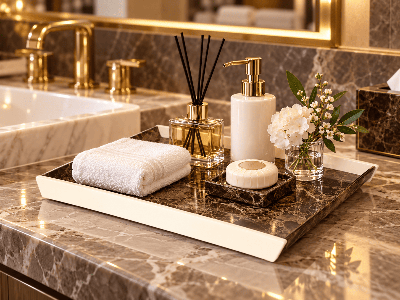
5: ToiletryTray Stability and Anti-Slip Feet
Stability depends on how the tray contacts the countertop and how its contents distribute weight. A heavy resin hotel amenity tray can still rock on an uneven base or slide across polished stone. Base flatness, foot position, grip, and normal loading therefore matter more than weight alone.
5.1 Base Contact and Anti-Slip Pads
A broad, flat base may provide sufficient stability on some surfaces, while polished marble, glass, or other smooth countertops may benefit from suitable rubber or silicone feet. Pads also separate the tray from the finish, but their protection depends on the material, cleanliness, and contact pressure.
Pad thickness and placement must be consistent. Uneven heights can cause rocking, and poorly bonded pads may detach before installation or during repeated cleaning. If the design includes feet, the production specification should identify their material, dimensions, positions, and attachment method rather than simply stating “anti-slip base.”
5.2 Test Stability on the Actual Countertop
An unloaded hotel toiletries tray may appear level yet move when guests remove a bottle or housekeeping places heavier items on one side. Test the approved arrangement on a representative countertop, first empty and then loaded as intended.
Apply the handling movements expected during normal use and examine rocking, sliding, contact marks, and pad movement. Inspect foot adhesion again after repeated lifting and wiping. The approved sample should establish the acceptable stability and surface-contact standard for bulk production.
6: Surface Finish and Daily Wear
A smooth or attractive finish does not necessarily withstand repeated hotel cleaning. Cleaning chemicals, wiping frequency, and contact with toiletry packaging can affect the appearance of a hotel amenity tray over time. Evaluate the finished surface under the property’s actual maintenance conditions, not just its appearance when new.
6.1 Surface Materials and Cleaning Compatibility
Acrylic, resin, wood, and PU leather trays require different surface-care procedures. Clear and dark acrylic finishes can make scratches and fingerprints more visible. Coated wood depends on the integrity of its protective finish, while PU leather surfaces require attention to coating wear, edge wrapping, and cleaning-agent compatibility.
Resin finishes also vary with their coating and manufacturing process.
For hotel bathroom trays, identify the cleaning chemicals, dilution ratios, contact times, and wiping materials used by housekeeping. Have the supplier document suitable cleaning methods and restrictions for the proposed finish. Chemical resistance should be assessed on the finished product, not inferred from the base material alone.
6.2 Check Scratches, Stains and Finish Changes
Surface appearance should be assessed against an approved standard. Fine scratches may be more noticeable on glossy black hotel vanity trays, while textured or patterned finishes may conceal minor marks but require closer inspection for trapped residue.
Use a finished sample to evaluate visible scratches, staining from representative toiletries, discoloration, and coating changes after the intended cleaning procedure. Establish acceptable appearance criteria under agreed lighting and inspection conditions, then retain the approved sample as a reference for bulk production.

7: Corners, Joints and Cleaning Access
The manufacturing method influences where dirt and toiletry residue can collect. A tray without visible exterior seams may still have tight internal corners that are difficult to wipe. Compare the actual construction of the bathroom amenity tray rather than judging cleanability from its overall appearance.
7.1 Molded and Assembled Tray Construction
Molded resin amenity presentation trays can have a continuous body without glued side joints, making them suitable for designs requiring a unified appearance. However, mold quality, corner radius, surface irregularities, and any separately attached components still need inspection.
Acrylic trays are commonly assembled from cut panels joined with adhesive. Their construction allows defined geometric forms, but the bonded edges require attention to alignment, glue marks, trapped bubbles, and uneven joints.
Neither construction is automatically easier to clean. The deciding factors are the finished corner geometry, joint quality, and accessibility of the surfaces that housekeeping must wipe.
7.2 Check Corners, Seams and Residue
Square internal corners, narrow channels, and poorly finished seams may retain dust, soap residue, or deposits from toiletry packaging. A cleaning cloth that reaches the flat base may not contact the entire corner.
Inspect the finished hotel toiletries tray for glue residue, bubbles along bonded joints, rough edges, and inaccessible recesses. During sample evaluation, apply a representative removable residue to the corners and clean the tray using the hotel’s normal tools. Any area that cannot be reached or cleaned satisfactorily should be revised before the design is approved.
8: Tray Weight and Daily Handling
Hospitality welcome tray weight should match the way housekeeping handles the product. A bathroom vanity tray that remains in place most of the day has different handling requirements from one lifted during every room cleaning. Assess the loaded weight, lifting frequency, and available grip before choosing a lighter or heavier design.
8.1 Lightweight and Heavy Tray Designs
Lightweight trays can reduce handling effort when staff frequently lift and reposition them. Heavier resin or thick-section designs may feel more substantial, but additional weight does not automatically improve durability or usability.
Large hotel amenity trays should be evaluated with their full amenity load, not by empty weight alone. Consider how far staff must move the tray, whether lifting requires one or two hands, and whether its weight affects routine countertop cleaning. There is no universal ideal weight; the acceptable range depends on the tray’s dimensions, contents, and handling routine.
8.2 Handles, Grip Access and Edge Design
Not every hotel vanity tray needs handles. Small trays may be lifted comfortably from accessible side edges or a recessed underside. Larger or frequently moved trays may benefit from integrated grip openings or attached handles.
Each option introduces different design requirements. Cut-out handles reduce material around the opening and need smooth, comfortable edges. Attached handles add connection points and may increase the overall footprint. Metal fittings in damp bathrooms also require suitable corrosion resistance.
For handle-free designs, establish where fingers can grip the tray without contacting the toiletries. For handled designs, specify the opening clearance, grip position, attachment method, and any projection beyond the tray body. The handle should support the intended lifting movement without obstructing the countertop arrangement.
8.3 Handling Tests During Housekeeping
A tray that is easy to lift when empty may be awkward once stocked with bottles, amenity packs, and other supplies. Staff may also need to raise it from a narrow space beside the sink without moving nearby accessories.
Trial the fully stocked tray during a normal housekeeping routine. Observe how staff grip, lift, carry, reposition, and set it down. Check whether the contents shift, the edges cause discomfort, or the handles interfere with surrounding fixtures.
Approve the handling design only after the sample can be moved and returned to its intended position without unnecessary rearrangement of the amenities.

9: Sample Approval and Bulk Production Quality
A satisfactory prototype does not guarantee consistent bulk production. The eight purchasing checks should become documented acceptance criteria covering product performance, construction, appearance, and packaging. Housekeeping evaluates how the tray works in the room; purchasing and the supplier use the approved sample and specifications to control the production order.
9.1 Housekeeping Sample Testing
Test the guest room accessory tray in a representative guestroom or bathroom using the actual toiletries and cleaning procedures. A showroom arrangement cannot reveal every problem staff may encounter during regular room servicing.
Rather than repeating each product specification, organize the trial around normal housekeeping tasks: preparing the amenity display, identifying missing items, replenishing supplies, wiping the tray and countertop, and returning everything to its designated position.
Record any difficulty, the required design correction, and the outcome of a second trial. Approval should reflect successful use under the agreed conditions, not appearance alone.
9.2 Approved Sample and Quality Standards
Once the trial is complete, establish a controlled reference for production. The approved sample should be accompanied by a dimensioned drawing and a written specification covering material, construction, external and usable dimensions, tolerances, color, finish, logo position, joints, and feet where applicable.
Define acceptable workmanship as well as major defects. For example, acrylic joints may need limits for visible glue marks, trapped bubbles, and misalignment, while finished surfaces require agreed criteria for scratches, color variation, and coating defects.
Keep the approved sample or an agreed reference set available for inspection. Any proposed change in material, construction, finish, or accessories should be reviewed and authorized before production rather than treated as an equivalent substitution.
9.3 Bulk Inspection and Packaging
Bulk inspection should verify conformity to the approved specification, not simply count finished trays. Agree on the inspection method, sampling plan, defect categories, and acceptance limits before production starts.
Inspect dimensions, appearance, workmanship, logo placement, and the consistency of attached components across the selected samples. For hotel vanity trays with protective feet, missing or poorly secured pads should be recorded as defects rather than left for the hotel to correct.
Packaging requires separate approval. Surface protection, individual separation, internal cushioning, carton strength, and packing orientation should suit the product’s weight, finish, and transport conditions. Evaluate a packed sample for likely handling damage, then confirm carton quantities, labeling, and the procedure for reporting transit defects.
Final approval should link the purchase order, approved sample, inspection records, and packing specification. This gives housekeeping, purchasing, and the supplier a common basis for resolving discrepancies before shipment.
For custom display trays fitted with anti-slip feet, request spare pads of the same material, size, thickness, and attachment type. Agree on the spare quantity before production and have the supplier pack and label them separately. This allows housekeeping to replace worn or detached feet without replacing the entire bathroom toiletries tray.
10: Hotel Amenity Tray Quote Checklist
Use this checklist before sending an RFQ and again before approving the final quotation.
1: Project brief:
Property type, guestroom or bathroom application, room count, tray quantity, delivery country, target date, and reference photos or drawings.
2: Comparable specifications:
Material, construction, external and usable dimensions, rim height, finish, base design, weight, handles, and logo requirements. Use consistent units across quotations.
3: Exact product configuration:
Material grade, thickness where applicable, color reference, joint construction, anti-slip feet, handle fittings, and approved substitutes.
4: Complete scope:
Unit price, MOQ, tooling, branding, samples, spare feet, protective packaging, freight terms, taxes where applicable, payment terms, and exclusions.
5: Evidence:
Dimensioned drawings, material and finish details, approved samples, cleaning restrictions, and relevant quality records.
6: Acceptance criteria:
Dimensional tolerances, appearance limits, workmanship, foot attachment, sample approval, bulk inspection, and packaging protection.
7: Delivery and support:
Sample and production lead times, inspection arrangements, shipping schedule, warranty coverage, replacement parts, and defect-handling procedure.
The final purchasing check is cost comparability: review quotations line by line. If one supplier excludes tooling, packaging, spare anti-slip feet, or freight, account for those costs before comparing prices.
10.1 Red Flags in a Hotel Amenity Tray Quote
Pause when a quotation describes only the material without construction details, omits usable dimensions, allows unspecified material substitutions, offers a sample without bulk-production acceptance standards, or promises protective packaging without defining it. Warranty claims without clear coverage or defect-handling terms also need clarification.
10.2 What to Send Goodfaith for an Accurate Quote
Send your required quantity, tray dimensions or reference design, preferred material, amenity packaging details, logo requirements, and delivery destination. Include countertop photos, cleaning requirements, and the target delivery date where available.
With these details, request a project-specific hotel amenity tray quotation from Goodfaith, including sample options, production lead time, and delivery terms.
Conclusion
The right hotel amenity tray is not necessarily the most attractive design or the lowest-priced option. Use this buying guide to match nine key specifications to your property’s housekeeping needs, approve a working sample, and compare complete supplier quotations before ordering.
Clear specifications and acceptance standards make differences in usability, product quality, maintenance requirements, and total purchasing cost easier to evaluate.
Leave a Reply
Want to join the discussion?Feel free to contribute!